NSG6001 Final Exam Study Guide LATEST VERSION 2019
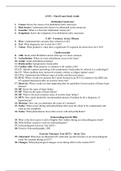
NSG6001 Final Exam Study Guide LATEST VERSION 2019 NSG6001 Final Exam Study Guide LATEST VERSION 2019 NSG6001 Final Exam Study Guide LATEST VERSION 2019 NSG6001 Final Exam Study Guide LATEST VERSION 2019 NSG6001 Final Exam Study Guide LATEST VERSION 2019 ANP I - Final Exam Study GuideAbdominal Aneurysm1. Causes: Know the causes of an abdominal aortic aneurysm.2. Risk factors: Understand risk factors for abdominal aortic aneurysm.3. Saccular: What is a Saccular Abdominal Aneurysm?4. Symptoms: Know the symptoms of an abdominal aortic aneurysm.CAD - Coronary Artery Disease5. Flow: Understand the coronary flow related to CAD.6. Test: What diagnostic test is used for CAD?7. Values: What predictive value does a significant ST-segment elevation have for CAD?Cardiovascular8. Afib: Study atrial fibrillation and at what age is it more common.9. Arrhythmias: Where do most arrhythmias occur in the heart?10. Atrial: Atrial arrhythmia treatment11. Bradycardia: Symptomatic bradycardia12. Cardiac cells: What property is common to all cardiac cells?13. CV: Should a patient presenting with symptomatic bradycardia be referred to a cardiologist?14. CV: What condition does narrowed coronary arteries or plague rupture cause?15. CVA: Understand the different types of stroke and their prevalence.16. ECG: Where would you measure the J point located on an ECG in relation to the QRS and ST segment depression after an exercise stress test?17. Heart dx: Where could you find supporting data for guidelines for prevention of future heart disease?18. HF: Know the types of heart failure.19. HF: What are the signs of heart failure?20. HF: What is the most common cause of systolic heart failure?21. HTN: How much should the recommended amount of sodium be for a diagnosis of hypertension?22. Murmur: How can you determine the cause of a murmur?23. Tachy: What occurs during tachyarrhythmias that cause the client to be symptomatic and what are the symptoms24. Tachy: What phenomenon most often occurs with tachyarrhythmia?Echocardiogram (ECHO)25. What is the best reason to add a Doppler flow studies during an echocardiogram study?26. What defines a positive exercise echocardiogram?27. Echocardiogram Exercise Test (EET)28. Exercise Echocardiography 2DEExercise Tolerance Test (ETT) – Stress Test29. Abnormal: What does an abnormal left ventricular ejection fraction on an echocardiogram mean for a patient during an ETT?30. Changes: What physiological changes occur during effort in the routine ETT?31. Farmingham: Know the reasons for using the risk stratification according to the Farmingham risk score to justify a ETT in an asymptomatic patient.32. Isometric: What is an Isometric ST-segment during exercise caused by?33. Negative: stress test result34. Order test: Why would you order an ETT in a symptomatic woman with a normal ECG?35. Positive: stress test result36. Predictive: What changes would you see during an ETT that are highly predictive of CAD?Ischemia37. Ischemia: EKG changes demonstrating ischemia38. Ischemic: Can ischemic changes on an ECG during or after an ETT correlate to the effected artery or arteries?39. Ischemic: Stress induced cardiac ischemiaMedicare40. Eligibility: Who is eligible for Medicare?41. Parts: Medicare Parts A, B, C, & D: What do they cover?42. Reimbursement: Does Medicare reimburse nurse practitioners for all services, including those deemed to be exclusive to nursing?Other43. Cancer: U.S. cancer deaths in men44. Cancer: U.S. leading cause of death in women45. Chlamydia:46. Collaboration: Which collaboration is the most important when caring for your patients?47. CT: Why is CT imaging limited in women?48. Cystitis: What is the treatment of choice for uncomplicated community-acquired cystitis?49. Fidelity: Know the difference between the principles of fidelity, veracity, self-reflection, and finance.50. GU: Differential diagnoses51. Healthcare: What are strategies in the movement to improve the healthcare system?52. Incontinence: Understand urinary incontinence and possible causes.53. Incontinence: Urinary incontinence and aging54. Pyelonephritis:55. Pyelonephritis: What pathogen accounts for the majority of cases of pyelonephritis?56. Self-management: What is self-management support?57. Self-management: What is the goal of self-management?58. STDs: Know the prevalence of sexually transmitted diseases in the USA.
Written for
- Institution
-
South University
- Course
-
NSG 6001 (NSG6001)
Document information
- Uploaded on
- April 24, 2019
- Number of pages
- 2
- Written in
- 2018/2019
- Type
- Study guide
Subjects
-
nsg6001 final exam study guide latest version 2019

Also available in package deal