ACC 557 Week 3, Quiz - Graded 100% Latest Version.docx
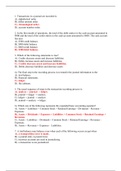
ACC 557 Week 3, Quiz - Graded 100% Latest V 1. Transactions in a journal are recorded in A). alphabetical order. B). dollar amount order. C). chronological order. D). account number order. 2. In the first month of operations, the total of the debit entries to the cash account amounted to $900 and the total of the credit entries to the cash account amounted to $600. The cash account has a(n) A). $300 credit balance. B). $900 debit balance. C). $600 credit balance. D). $300 debit balance. 3. Which of the following statements is true? A). Credits decrease assets and decrease liabilities. B). Debits increase assets and increase liabilities. C). Credits decrease assets and increase liabilities. D). Debits decrease liabilities and decrease assets 4). The final step in the recording process is to transfer the journal information to the A). trial balance. B). financial statements. C). ledger. D). file cabinets. 5. The usual sequence of steps in the transaction recording process is: A). analyze→ journal → ledger. B). journal→ ledger → analyze. C). ledger→ journal → analyze. D). journal→ analyze → ledger. 6). Which one of the following represents the expanded basic accounting equation? A). Assets = Liabilities Common Stock Retained Earnings Dividends – Revenue – Expenses. B). Assets Dividends Expenses = Liabilities Common Stock Retained Earnings Revenues. C). Assets – Liabilities – Dividends = Common Stock Retained Earnings Revenues – Expenses. D). Assets = Revenues Expenses – Liabilities. 7. A trial balance may balance even when each of the following occurs except when A). a transposition error is made. B). a journal entry is posted twice. C). incorrect accounts are used in journalizing. D). a transaction is not journalized. 8). An accounting time period that is one year in length, but does not begin on January 1, is referred to as A). a fiscal year. B). an interim period. C). the time period assumption. D). a reporting period. 9). Which of the following reflect the balances of prepayment accounts prior to adjustment? A). Balance sheet accounts are understated and income statement accounts are understated. B). Balance sheet accounts are overstated and income statement accounts are overstated. C). Balance sheet accounts are understated and income statement accounts are overstated. D). Balance sheet accounts are overstated and income statement accounts are understated. 10). Crue Company had the following transactions during 2013: • Sales of $4,500 on account • Collected $2,000 for services to be performed in 2014 • Paid $1,625 cash in salaries • Purchased airline tickets for $250 in December for a trip to take place in 2014 What is Crue’s 2013 net income using cash basis accounting? A). $375. B). $4,875. C). $4,625. D). $125. 11). Which statement is correct? A). The cash basis of accounting is objective because no one can be certain of the amount of revenue until the cash is received. B). As long as management is ethical, there are no problems with using the cash basis of accounting. C). As long as a company consistently uses the cash basis of accounting, generally accepted accounting principles allow its use. D). The use of the cash basis of accounting violates both the revenue recognition and expense recognition principles. 12). Under accrual-basis accounting A). net income is calculated by matching cash outflows against cash inflows. B). the ledger accounts must be adjusted to reflect a cash basis of accounting before financial statements are prepared under generally accepted accounting principles. C). cash must be received before revenue is recognized. D). events that change a company's financial statements are recognized in the period they occur rather than in the period in which cash is paid or received. 13). Expenses paid and recorded as assets before they are used are called A). accrued expenses. B). interim expenses. C). prepaid expenses. D). unearned expenses. 14). The adjusted trial balance is prepared A). after financial statements are prepared. B). after adjusting entries have been journalized and posted. C). before the trial balance. D). to prove the equality of total assets and total liabilities 15). Management usually desires ________ financial statements and the IRS requires all businesses to file _________ tax returns. A). quarterly, monthly B). monthly, annual C). monthly, monthly D). annual, annual
Written for
Document information
- Uploaded on
- May 9, 2019
- Number of pages
- 3
- Written in
- 2018/2019
- Type
- Exam (elaborations)
- Contains
- Only questions
Subjects
- acc 557 week 3
-
quiz graded 100 latest versiondocx

Also available in package deal