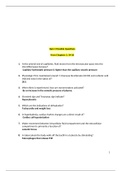
NR 507 Week 2 Quiz Possible Questions Chapter 3, 34-36
1. Question: At the arterial end of capillaries, fluid moves from the intravascular space into the interstitial space because? 2. Question:Physiologic PH is maintained around 7.4 because bicarbonate (HCO3) and carbonic acid (H2CO3) exist in the ration of? 3. Question:When thirst is experienced, how are osmoreceptors activated? 4. Question:Chvostek sign and Trousseau sign indicate? 5. Question:Which are the indications of dehydration? 6. Question:In hyperkalemia, cardiac rhythm changes are a direct result of? 7. Question:Water movement between intracellular fluid compartment and the extracellular compartment is primarily a function of? 8. Question:In tuberculosis the body walls off the bacilli in a tubercle by stimulating? 9. Question:Pulmonary edema usually begins at a pulmonary capillary wedge pressure or left atrial pressure ______ 10. Question:Which inflammatory mediators are produced in asthma? 11. Question:The most successful treatment for chronic asthma begins with? 12. Question:Which pleural abnormality involves a site of pleural rupture that act as a one-way valve permitting air to enter on inspiration but preventing its escape by closing during expiration? 13. Question: ______ is a fulminant form of respiratory failure characterized by acute lung inflammation and diffuse alveolocapillary injury. 14. Question:In ARDS, alveoli and respiratory bronchioles fill with fluid as a result of the? 15. Question:Clinical manifestations that include unexplained weight loss, dyspnea on exertion, use of accessory muscles, and tachypnea with prolonged expiration are indicative of? 16. Question: Clinical manifestations of pulmonary hypertension include? 17. Question: Dyspnea is not a result of? 18. Question: High altitudes may produce hypoxemia through? 19. Question: Chest wall compliance in infants is _______in adults 20. Question: What is the primary cause of RDS of the newborn? 21. Question: An accurate description of childhood asthma is that it is a (n)? 22. Question: Cystic fibrosis (CF) is caused by a (n)? 23. Question: Which of the following statements about the advances in the treatment of RDS of the new born is incorrect? 24. Question: Which of the following types of croup is most common? 25. Question: Which immunoglobulin is present in childhood asthma? 26. Question: What is a major determinant of the resting membrane potential necessary for transmission of nerve impulses? 27. Question: Why are infants susceptible to significant losses in total body water (TBW)? 28. Question: At the arterial end of capillaries, fluid moves from the intravascular space into the interstitial space because the 29. Question: A(n) _____ is a circumscribed area of suppuration and destruction of lung parenchyma. 30. Question: The most successful treatment for chronic asthma begins with 31. Question: Kussmaul respirations may be characterized as a respiratory pattern? 32. Question: Which of the following is a true statement? 33. Question: High altitudes may produce hypoxemia through? 34. Question: In tuberculosis, the body walls off the bacilli in a tubercle by stimulating? 35. Question: An accurate description of childhood asthma is that it is a(n) 36. Question: In hyperkalemia, cardiac rhythm changes are a direct result of 37. Question: How does the loss of chloride during vomiting cause metabolic alkalosis? 38. Question: Which enzyme is secreted by the juxtaglomerular cells of the kidney when circulation blood volume is reduced? 39. Question: Which statement best describes a Schilling test?
Written for
- Institution
-
Chamberlain
- Study
-
Nursing
- Module
-
NR 507 (NR507)
Document information
- Uploaded on
- May 31, 2019
- Number of pages
- 4
- Written in
- 2018/2019
- Type
- Answers
- Person
- Unknown
Subjects
- nr 507
- nr 507 week 2
- nr 507 week 2 quiz
- 34 36
-
nr 507 quiz possible questions chapter 3
-
nr 507 week 2 possible questions

Also available in package deal